Working in the lab

Research at Sahlgrenska Academy involves laboratory work and use of chemicals. Some of these chemicals are hazardous to the environment. It is therefore important to handle them correctly in order to reduce the risk of environmental contamination.

Click on the various headings to read more.
Working in the labLab safety

Lab safety

When you work with chemical products in the laboratory, always use proper clothing (laboratory coat and gloves). If necessary, use protective eyewear as well.

Work involving flammables, hazardous or corrosive chemicals must be carried out in a fume hood or on a ventilated bench. Please note that evaporation of chemicals in the fume hood is not allowed. Use a tray (or similar) to prevent chemical leakage into the drain when you work in the fume cupboard.

Note that using a chemical fume hood is one of the most energy-intensive aspects of laboratory work. Ensure that the front glass is shut after the work is completed.

Clean up after finishing your work and dispose of the waste according to the local regulations.

Working in the labRisk assessment an KLARA chemical database

  • Obligation

    A risk assessment should be performed before all work is done or chemicals are purchased.

    Under the Swedish Work Environment Authority’s Ordinance on Operator Self-inspections (1998:901) and Provisions and General Recommendations (AFS 2011:19) on Chemical Hazards in the Working Environment, risk assessments should be carried out before work with hazardous chemicals begins. Risk assessments are conducted to identify chemical risks, which should be examined and assessed as frequently as conditions require in order to prevent accidents, injuries at work, and environmental impacts.

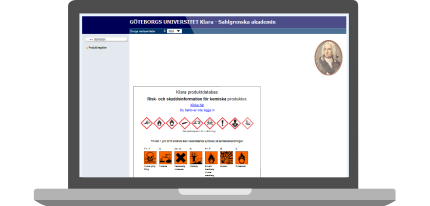
    By law, chemicals that pose hazardous risks to health and/or the environment must be listed. The University of Gothenburg uses the KLARA chemical database.

    A web-based system

    Uses of the KLARA system

    • Obtaining safety information on hazards associated with chemical products (safety data sheets, SDS).

    • Searching for chemical information.

    • Retrieving lists of chemicals and finding out where they are kept in the lab.

    • Performing risk assessments.

    Link to the KLARA database: https://medarbetarportalen.gu.se/verktyg/klara/

  • Safety data sheet (SDS)

    An SDS is a summary document from the supplier that must provide information about the product concerning occupational safety, environmental risks, health aspects, etc. The supplier must always be able to offer an SDS in the official language in the location where the product is marketed.

    An SDS invariably contains 16 sections and includes, for example, instructions for safe use; potential hazard identification and its labeling with hazard pictograms; and procedures for managing spillage.

    1. Identification of the substance or mixture and of the company or enterprise
    2. Hazard identification
    3. Composition of, and other information about, ingredients
    4. First aid measures
    5. Firefighting measures
    6. Accidental release measures
    7. Handling and storage
    8. Exposure controls and personal protection
    9. Physical and chemical properties
    10. Stability and reactivity
    11. Toxicological information
    12. Ecological information
    13. Disposal considerations
    14. Transport information
    15. Regulatory information
    16. Other information

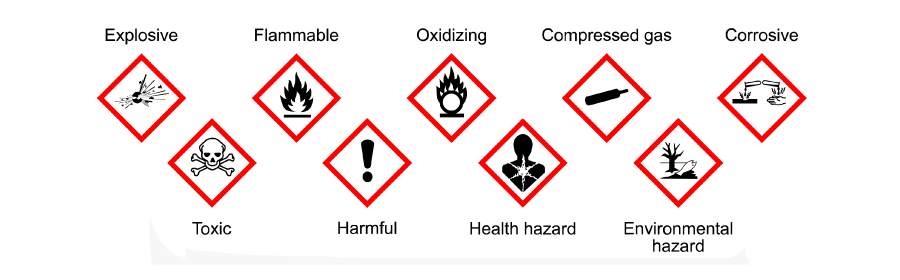
  • Hazard pictograms and their meaning

    The CLP Regulation adopts the United Nations’ Globally Harmonized System on the Classification and Labelling of Chemicals (GHS).

    The pictograms, in combination with signaling words, are used to show the hazardous risks of chemicals.

    A more detailed classification, with “H” phrases (hazard statements) and “P” phrases (precautionary statements), may be found in the safety data sheet (SDS) under Section 2, Hazard identification.

  • CMR chemical products

    Under the Swedish Work Environment Authority’s Provisions and General Recommendations (AFS 2011:19) on Chemical Hazards in the Working Environment, in addition to a risk assessment, a special CMR investigation of potential substitution of less hazardous chemicals must be performed (and the report signed by the group leader).

    In the event of anyone being exposed to a CMR chemical, a record of the incident must be signed by the group leader and saved for 40 years.

    CMR-classified chemical products are those marked with the following hazard statements and/or risk wording.

    H350: May cause cancer
    H340: May cause genetic defects
    H360: May damage fertility or the unborn child
    R45: May cause cancer
    R46: May cause inheritable genetic damage
    R49: May cause cancer by inhalation
    R60: May impair fertility
    R61: May cause harm to the unborn child

  • Chemical substitutions

    Replace hazardous chemicals with substances that are less dangerous for the environment and human health. The chemicals of highest concern are based on the criteria established by the EU chemicals regulation REACH (Registration, Evaluation, Authorization and Restriction of Chemicals).

    Substitutions can be effected by:

    1. Using less hazardous chemicals in the experiment.

    2. Developing a new methodological design that makes it possible to minimize the amount of the hazardous chemical or exclude and replace it.

Working in the labStorage of chemicals

Storage

Safe storage of chemical products is important to reduce the risks of damage to the environment and human health.

Examples of basic storage rules:
1. Acids and bases must be stored separately in ventilated cabinets.
2. Hazardous chemical products must be stored in ventilated and locked cabinets.
3. Flammable chemical products must be stored in flammable-safe, ventilated cabinets, marked on the outside with pictograms corresponding to the stored products.

For more detailed list see: https://medarbetarportalen.gu.se

Read the Safety Data Sheet under Section 7, “Handling and storage,” to find out how to store every chemical product correctly.

Working in the labLab waste

  • Basic principle

    All chemical solutions that differ, in chemical content, from standard household waste must be collected in special containers and sent for destruction as hazardous waste.

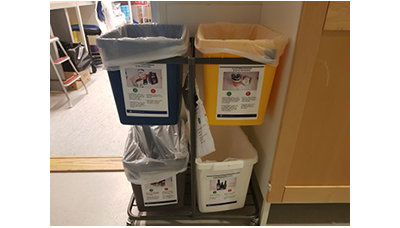
    There are two fractions of hazardous waste in the lab: hazardous chemical waste and hazardous waste. The third fraction from lab is clean plastic, glassware, metal, and cardboard. Containers for these fractions may be found in the corridors outside the lab.

    Environmentally dangerous and hazardous substances, such as heavy metals and some organic compounds that are persistent, toxic, bioaccumulative (stored in living organisms), or nitrification-/denitrification-inhibiting (major nitrogen removal), must never be poured into the sewer network.

    See 6.2 Wastewater drainage and chemical products in: https://medarbetarportalen.gu.se

  • Chemical waste is generated from lab work (inorganic or organic chemicals). For more information, see:https://medarbetarportalen.gu.se

    Hazardous chemical waste (farligt avfall)

    Hazardous chemical waste is generated when chemicals are used during lab work. They may be inorganic or organic solid chemicals and/or solutions.
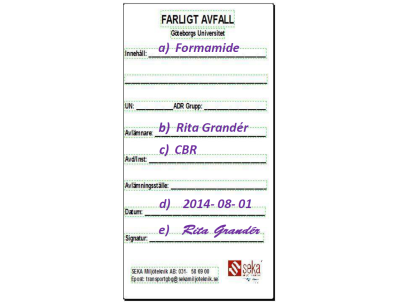

    Chemical waste or residues that differ in their chemical content from standard household waste must be collected and sent for destruction as hazardous chemical waste.

    NOTE. Never dispose of hazardous chemical waste by evaporation, down the drain or in the trash.

    Hazardous waste (riskavfall)

    Sharps, radioactive waste, contagious waste, biological waste, biological waste agar plates, cytostatic waste, human waste, blood waste, and pharmaceutical waste must be packaged and marked in specific ways.

    NOTE. Do not dispose of hazardous waste by evaporation, down the drain or in the trash.

  • General rules for handling hazardous chemical waste (farligt avfall)

    Liquid hazardous chemical waste
    Choose original packaging or appropriately labeled container (see SDS). Label the waste container FARLIGT AVFALL.

    Solid hazardous chemical waste
    This type of waste can be disposed in its original packaging or in other appropriate container. Label the waste container FARLIGT AVFALL.

  • Hazardous waste (riskavfall)

    Hazardous waste is containing the following waste:

    • Biological waste (e.g. cell culture medium).
    • Hazardous sharps (needles, scalpels, broken glass from the lab).
    • Hazardous sharps and contagious waste.
    • Pharmaceuticals.
    • Infectious items.
    • Genetically modified micro-organism waste (noninfectious).
    • Genetically modified micro-organism waste (infectious).
    • Radioactive chemicals or items.
    • Contaminated gloves, pipette tips, emptied vials, and bench paper.
    • Contaminated items that have been used for non-hazardous chemicals, such as napkins, paper towels, gloves, pipette, pipette tips, empty vials, etc.

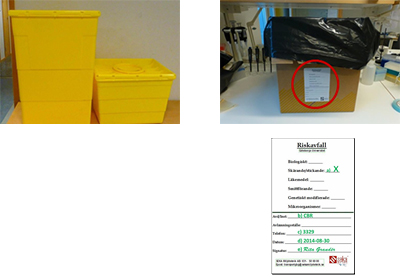
    Use either the yellow plastic container or the carton labeled “Riskavfall”. Label the waste container “Riskavfall”.

  • Correct sorting

    Drag and drop the waste in it’s appropriate bin.

    Stand for plastic items
    Hazardous chemical waste
    Hazardous waste